TFA Full Form: What Does TFA Stand For? Meaning & Uses
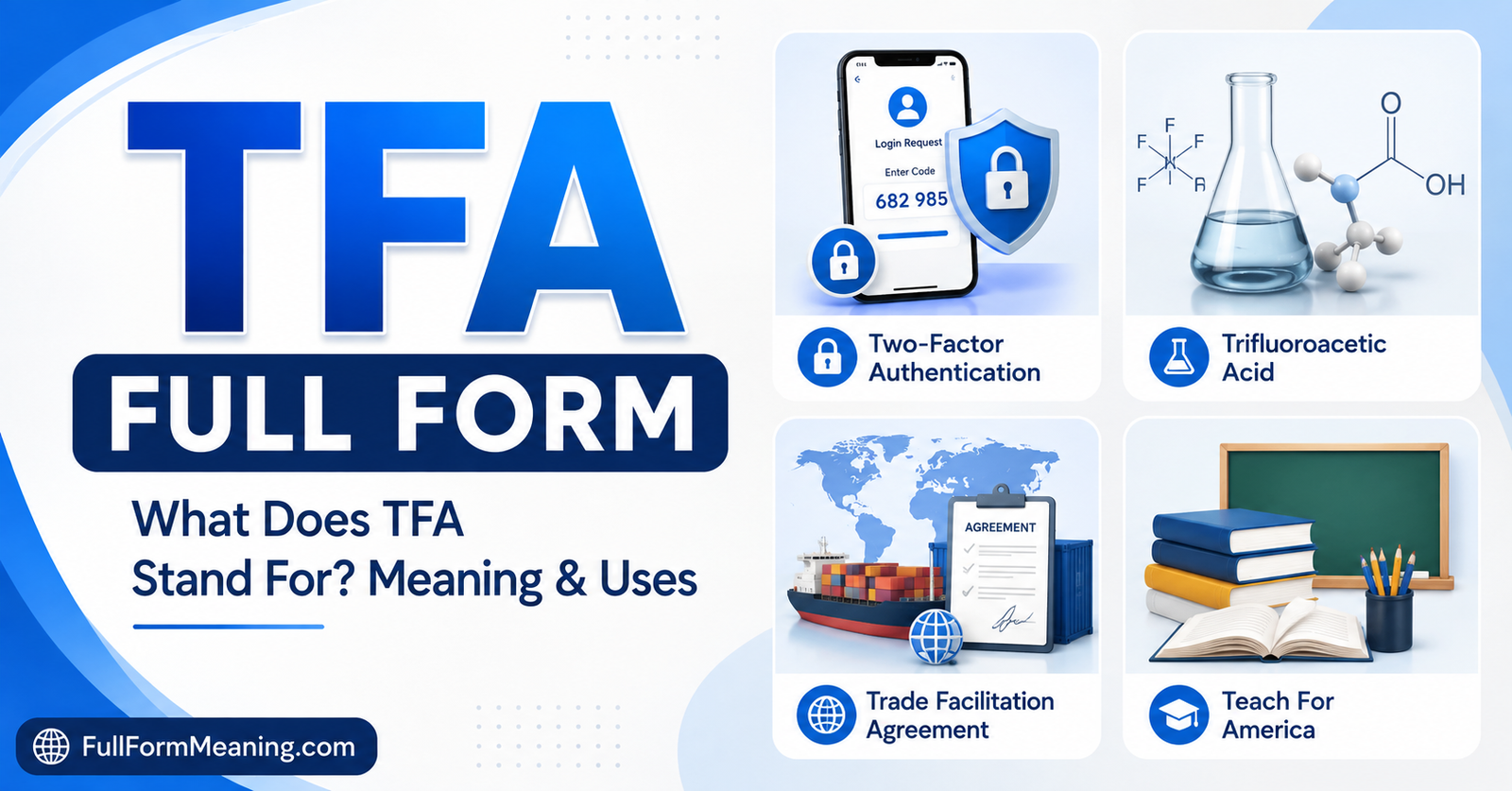
TFA full form depends on the context in which the abbreviation is used. In technology and cybersecurity, TFA commonly stands for Two-Factor Authentication, a security method that requires two different authentication factors to verify a user’s identity. The term is also used in chemistry for Trifluoroacetic Acid, in international trade for Trade Facilitation Agreement, and in education and nonprofit work for Teach For America.
Because TFA has several meanings, understanding the context is important. This guide explains the most common TFA full forms, their meanings, uses, examples, and related terms.
TFA Full Form at a Glance
| Information | Details |
| Abbreviation | TFA |
| Common technology full form | Two-Factor Authentication |
| Technology category | Cybersecurity |
| Chemistry full form | Trifluoroacetic Acid |
| International trade full form | Trade Facilitation Agreement |
| Education/nonprofit full form | Teach For America |
| Type | Acronym/initialism depending on context |
| Meaning | Varies according to the field |
What Is the TFA Full Form?
The TFA full form in cybersecurity is Two-Factor Authentication. It is a method of protecting an account by requiring two authentication factors rather than relying only on a password.
For example, when you sign in to an online account, you might first enter your password and then enter a verification code sent to your phone or generated by an authentication application. These two steps provide an additional layer of protection.
The Canadian Centre for Cyber Security lists TFA as an abbreviation for Two-Factor Authentication, while other security resources commonly use 2FA for the same concept.
Simple Definition
TFA means Two-Factor Authentication, a security process that verifies a person’s identity using two separate authentication factors.
The idea is simple: even if someone obtains your password, they may still be unable to access your account without the second authentication factor.
How Does Two-Factor Authentication Work?
Two-factor authentication generally combines two different types of credentials.
1. Something You Know
This is information that only the user should know, such as:
- Password
- PIN
- Security answer
2. Something You Have
This is an object or device that the user possesses, such as:
- Mobile phone
- Security key
- Authentication device
- Authentication application
3. Something You Are
Biometric information can also be used as an authentication factor, including:
- Fingerprint
- Facial recognition
- Other biometric characteristics
CISA describes authentication factors using categories such as something you know, something you have, and something you are.
For example, a website may require a password plus a code generated by an authentication application. The password represents something you know, while access to the authentication device represents something you have.
Why Is TFA Important?
Passwords alone can be compromised through phishing, password reuse, data breaches, guessing, or other attacks. Two-factor authentication adds another barrier between an attacker and an account.
Suppose someone obtains your password. With TFA enabled, the attacker may still need the second authentication factor before gaining access.
This is why security organizations encourage users to enable multifactor authentication whenever it is available. CISA recommends using MFA and notes that common methods include text messages, authentication applications, and phishing-resistant authentication.
Benefits of TFA
Some important benefits include:
- Adds another layer of account protection
- Reduces dependence on passwords alone
- Helps protect email and social media accounts
- Can reduce the impact of stolen passwords
- Helps protect sensitive information
- Supports stronger identity verification
TFA does not make an account completely immune to attacks, but it can significantly strengthen the authentication process.
TFA vs 2FA: Are They the Same?
In many technology contexts, TFA and 2FA refer to the same basic concept: Two-Factor Authentication. However, 2FA is generally the more widely recognized abbreviation.
The terminology can vary between organizations, software platforms, and documentation. For example, official cybersecurity guidance may use TFA, while many websites display an option called “2FA” or “Two-Step Verification.”
The important distinction is between two-factor authentication and broader MFA (Multifactor Authentication).
2FA/TFA specifically involves two factors. MFA is the broader term for authentication involving multiple independent factors and can include two or more factors.
Examples of TFA in Everyday Technology
You may encounter TFA when:
- Logging into an email account
- Accessing online banking
- Signing into a social media account
- Connecting to a company’s internal system
- Accessing cloud services
- Logging into an educational platform
- Protecting an administrator account
Example
Imagine that you log in to an account using:
Step 1: Enter your password.
Step 2: Enter a six-digit verification code from an authentication application.
The account is using two authentication factors.
TFA Full Form in Chemistry
In chemistry, TFA stands for Trifluoroacetic Acid.
Trifluoroacetic acid is a chemical compound with the molecular formula C₂HF₃O₂, also written as CF₃COOH. PubChem identifies it as a strong halogenated derivative of acetic acid and notes applications including chemical synthesis and solvent use.
TFA is commonly encountered in:
- Organic chemistry
- Chemical synthesis
- Peptide research
- Laboratory research
- Chromatography
- Pharmaceutical research
It is important to distinguish this meaning from Two-Factor Authentication. If TFA appears in a chemistry laboratory document, research paper, or chemical specification, Trifluoroacetic Acid is likely the intended meaning.
TFA Full Form in International Trade
In international trade, TFA stands for Trade Facilitation Agreement.
The World Trade Organization (WTO) uses TFA to refer to the Trade Facilitation Agreement, which aims to simplify, modernize, and harmonize import, export, and transit procedures. The agreement entered into force on February 22, 2017, after the required ratification threshold was reached.
The agreement focuses on making the movement, release, and clearance of goods more efficient. It also includes measures involving customs cooperation, transparency, documentation, and technical assistance.
Why Is the Trade Facilitation Agreement Important?
International trade can involve extensive documentation, customs procedures, inspections, and border requirements. Trade facilitation seeks to reduce unnecessary delays and make these processes more efficient.
The WTO continues to work with members on implementation and review of the agreement. In 2026, WTO members continued discussions related to the second review of the TFA.
TFA Full Form in Education and Nonprofit Work
TFA can also stand for Teach For America, a nonprofit organization associated with education and teacher recruitment in the United States. Acronym references list Teach For America among the established meanings of TFA.
When TFA appears in discussions about teachers, education programs, schools, or educational leadership, Teach For America may be the intended meaning rather than Two-Factor Authentication.
For example:
“She applied to TFA after completing college.”
In an education-related context, TFA may refer to Teach For America.
Other Meanings of TFA
Because acronyms can be reused across industries, TFA has additional meanings. Some documented examples include:
| TFA Full Form | Context |
| Two-Factor Authentication | Cybersecurity |
| Trifluoroacetic Acid | Chemistry |
| Trade Facilitation Agreement | International trade |
| Teach For America | Education/nonprofit |
| Thanks For Asking | Informal communication |
| Time-Frequency Analysis | Signal processing |
| Total Flow Area | Petroleum industry |
| Toughest Firefighter Alive | Firefighter competition |
Acronym references document many additional expansions, demonstrating why the surrounding context matters when interpreting TFA.
TFA in Texting and Online Communication
In informal online communication, TFA can mean “Thanks For Asking.” This is an abbreviation rather than a technical term.
For example:
Person A: “How are you feeling today?”
Person B: “I’m doing much better, TFA.”
Here, TFA is being used as a short form of “Thanks For Asking.”
This meaning is less likely when TFA appears in a cybersecurity, chemistry, business, or academic document. Context should always determine the interpretation.
How to Identify the Correct TFA Meaning
The easiest way to determine the correct TFA full form is to examine the surrounding subject.
If the topic is cybersecurity
TFA most likely means Two-Factor Authentication.
Look for words such as:
- Password
- Login
- Verification code
- Security
- Authentication
- Account
If the topic is chemistry
TFA likely means Trifluoroacetic Acid.
Look for terms such as:
- Chemical formula
- Organic synthesis
- HPLC
- Peptides
- Solvent
- Reagent
If the topic is international trade
TFA likely means Trade Facilitation Agreement.
Look for:
- WTO
- Customs
- Imports
- Exports
- Border procedures
- Trade
If the topic is education
TFA may mean Teach For America.
Look for:
- Teachers
- Schools
- Education
- Corps members
- Teaching
- Leadership
Common Examples of TFA
Here are a few examples showing how the abbreviation changes meaning according to context:
Cybersecurity:
“Enable TFA to add an extra security step to your account.”
Chemistry:
“The researcher used TFA during the laboratory procedure.”
International trade:
“The country is working toward implementing the WTO TFA.”
Education:
“She learned about the TFA teaching program during college.”
Texting:
“TFA! I really appreciate you asking.”
These examples demonstrate why simply expanding an acronym without considering context can lead to an incorrect interpretation.
Is TFA an Acronym or an Abbreviation?
TFA can be described as an initialism or abbreviation, depending on how the term is used and the definition being discussed.
It is formed from the initial letters of phrases such as Two-Factor Authentication, Trifluoroacetic Acid, and Trade Facilitation Agreement.
Unlike a word such as “radar,” which is commonly pronounced as a single word, TFA is generally pronounced by saying its individual letters: T-F-A.
Related Terms You Should Know
If you are learning about TFA in cybersecurity, several related terms are useful:
- 2FA: Two-Factor Authentication
- MFA: Multifactor Authentication
- OTP: One-Time Password
- PIN: Personal Identification Number
- TOTP: Time-Based One-Time Password
- Biometric Authentication: Identity verification using biological characteristics
- Authentication: The process of verifying a user’s identity
Understanding these terms makes it easier to understand how modern account security works.
FAQs About TFA Full Form
What is the full form of TFA?
The most common technology-related full form of TFA is Two-Factor Authentication. However, TFA has other established meanings, including Trifluoroacetic Acid and Trade Facilitation Agreement.
What does TFA mean in cybersecurity?
In cybersecurity, TFA means Two-Factor Authentication. It requires two authentication factors to verify a user’s identity before granting access.
Is TFA the same as 2FA?
In many contexts, yes. TFA and 2FA can both refer to Two-Factor Authentication, although 2FA is a more commonly recognized abbreviation in many consumer-facing services.
What is the TFA full form in chemistry?
In chemistry, TFA stands for Trifluoroacetic Acid. Its molecular formula is C₂HF₃O₂, or CF₃COOH.
What is the TFA full form in international trade?
In international trade, TFA stands for Trade Facilitation Agreement, a WTO agreement designed to improve and simplify procedures for moving goods across borders.
What does TFA mean in education?
TFA can refer to Teach For America in an education and nonprofit context.
What does TFA mean in texting?
In informal texting, TFA can mean Thanks For Asking. It is an informal abbreviation and should be interpreted from the surrounding conversation.
Why are there different TFA full forms?
TFA is a three-letter abbreviation used independently by different industries and organizations. Therefore, its meaning changes according to context.
Which TFA meaning is used for account security?
Two-Factor Authentication is the relevant meaning when discussing account login, passwords, verification codes, authentication applications, or cybersecurity.
Is TFA a security method?
Yes. When TFA means Two-Factor Authentication, it is a security method that requires two distinct authentication factors to verify identity.
What is the difference between TFA and MFA?
TFA generally refers specifically to two authentication factors, while MFA is the broader term for authentication involving multiple independent factors. Two-factor authentication is therefore a type of multifactor authentication.
Related Full Forms
For readers researching cybersecurity and authentication, these related terms are useful:
- 2FA — Two-Factor Authentication
- MFA — Multifactor Authentication
- OTP — One-Time Password
- TOTP — Time-Based One-Time Password
- PIN — Personal Identification Number
- SSO — Single Sign-On
- IAM — Identity and Access Management
Conclusion
The TFA full form depends on the context. In cybersecurity, TFA commonly means Two-Factor Authentication, a method that uses two authentication factors to provide stronger account protection. In chemistry, TFA means Trifluoroacetic Acid. International trade, it means Trade Facilitation Agreement, while in education it can refer to Teach For America.
Therefore, when you encounter TFA, always consider the subject surrounding the abbreviation. If the discussion involves passwords and account security, Two-Factor Authentication is likely intended. If it concerns laboratory chemistry, international commerce, or education, a different expansion may apply.
Understanding the context is the key to identifying the correct TFA meaning and full form.