DEAF Full Form: Meaning, Definition, and What DEAF Stands For
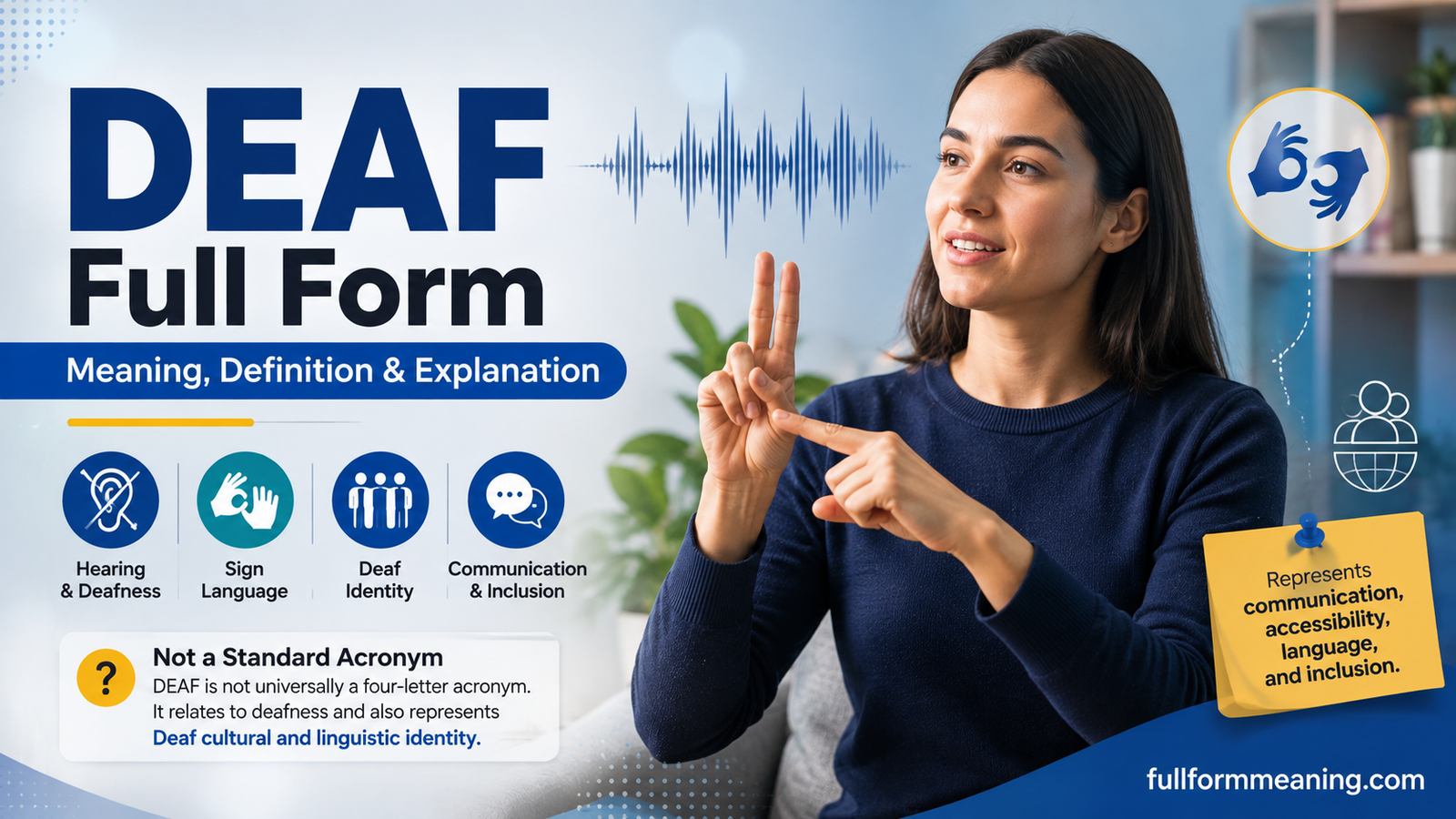
DEAF full form does not have a universally recognized official expansion as a four-letter acronym. The word deaf is primarily an English term used to describe a person with significant hearing loss, while Deaf, with a capital “D,” can describe a cultural and linguistic identity associated with the Deaf community.
This distinction is important because many online full-form searches assume that every word written in capital letters must represent an acronym. In this case, that assumption can lead to invented or misleading expansions. A reliable explanation should instead focus on the established meaning, medical context, cultural usage, and related terminology.
Quick Answer: DEAF Full Form
DEAF does not have a standard, universally accepted full form. It is normally the English word deaf, referring to a person who has little or no hearing, particularly in contexts involving profound hearing loss. WHO notes that people described as deaf mostly have profound hearing loss, while people who are hard of hearing generally have hearing loss ranging from mild to severe.
When written as Deaf with a capital “D,” the term can have a broader cultural meaning. It may refer to people who identify with Deaf culture and the Deaf community, often including people whose primary language or communication method is a sign language.
| Term | Meaning | Main Context |
| deaf | A term associated with significant or profound hearing loss | Medical/general |
| Deaf | A cultural and linguistic identity | Deaf community and culture |
| hard of hearing | Hearing loss ranging from mild to severe | Medical/general |
| hearing loss | Reduced ability to hear compared with normal hearing | Medical/health |
What Does DEAF Stand For?
Unlike abbreviations such as NASA, WHO, or CPU, DEAF is not generally formed from the initial letters of four separate words. Therefore, there is no single official expansion that can accurately be presented as the “full form” in every situation.
The lowercase word deaf is an ordinary English adjective and noun-related term rather than a conventional acronym. It is used in discussions involving hearing ability, communication, education, accessibility, and health.
This is why a trustworthy full-form explanation should avoid assigning an invented phrase to each letter of the word. If a particular organization, project, course, or program uses DEAF as an acronym, its expansion would need to be verified from that specific organization’s official terminology rather than assumed to be universal.
Meaning of Deaf
The term deaf generally refers to a person who has very little or no hearing. WHO explains that hearing loss can range from mild to profound and may affect one or both ears. People described as deaf mostly have profound hearing loss, although individual hearing abilities and communication preferences vary.
The term can therefore have both a functional and social dimension.
From a hearing perspective, it describes the degree to which a person can perceive sound. From a social or cultural perspective, some people identify as members of a Deaf community that shares language, experiences, traditions, and cultural identity.
It is important not to assume that every person with hearing loss communicates in exactly the same way. Some people use sign language, while others communicate primarily through spoken language, hearing technology, captioning, or a combination of methods.
Deaf vs. Deaf: Why Capitalization Matters
One of the most important points when researching this term is the difference between deaf and Deaf.
Lowercase “deaf”
The lowercase form generally refers to the physical condition or experience of having significant hearing loss. A person may have little or no functional hearing without necessarily identifying with Deaf culture.
Capital “Deaf”
The capitalized form can indicate a cultural identity. WHO describes Deaf with a capital “D” as a cultural identity for people with hearing loss who may identify strongly with Deaf culture and the Deaf community.
This distinction is not simply a spelling preference. It can communicate whether the discussion concerns hearing status or cultural and linguistic identity.
Deaf vs. Hard of Hearing
The terms deaf and hard of hearing are related but should not automatically be treated as interchangeable.
WHO describes people who are hard of hearing as generally having hearing loss ranging from mild to severe. They may commonly communicate through spoken language and can benefit from hearing aids, cochlear implants, captioning, and other assistive technologies. People who are deaf mostly have profound hearing loss, meaning very little or no hearing.
However, hearing ability exists across a broad spectrum, and terminology can depend on personal preference, cultural identity, communication method, and context.
Simple comparison
| Term | General explanation |
| Deaf | May describe a cultural identity as well as people with profound hearing loss |
| deaf | Generally refers to significant hearing loss or limited/no hearing |
| Hard of hearing | Usually refers to mild-to-severe hearing loss |
| Hearing loss | General term for reduced hearing ability |
Is DEAF an Acronym?
No, not in its ordinary use. The word deaf is not normally an acronym that needs to be expanded into four separate words.
This is especially important for students and people researching full forms online. Searching for a “full form” does not necessarily mean that a legitimate four-word expansion exists. Some search terms are ordinary words, names, abbreviations, or context-specific labels rather than conventional acronyms.
If you encounter a phrase claiming that each letter in DEAF represents a different word, it should be treated cautiously unless that expansion can be traced to a recognized organization or specific context.
Where Is the Term Used?
The term appears across several areas, including:
- Healthcare: discussions of hearing loss, deafness, diagnosis, and rehabilitation.
- Education: deaf education, accessible learning, sign-language instruction, and classroom accommodations.
- Communication: sign language, captioning, speech reading, and assistive communication.
- Culture: Deaf identity, Deaf culture, and Deaf community discussions.
- Accessibility: services and technologies designed to improve participation in education, employment, and everyday activities.
- Public policy: disability access, communication rights, health services, and inclusion.
WHO recommends rehabilitation and accessibility measures that can include hearing technologies, speech and language therapy, sign-language training, captioning, interpreting, and other assistive services.
Communication and Sign Language
Sign language is an important communication method for many people who are deaf or hard of hearing. NIDCD defines sign language as a communication method using hand movements, gestures, and facial expressions to convey grammatical structure and meaning.
However, there is no single universal sign language used by all Deaf people worldwide. Different countries and communities can have their own signed languages, just as spoken languages differ between countries.
Communication preferences also vary from person to person. Depending on individual circumstances, someone may use sign language, spoken language, speech reading, captioning, hearing devices, or several methods together.
Common Misunderstanding About the Full Form
The biggest misunderstanding surrounding DEAF full form of DEAF is the belief that the term must have an official four-word expansion simply because it is typed in capital letters.
That is not necessarily true.
A word can be entered into a search engine as a “full form” query even when it is not an acronym. In such cases, the correct approach is to explain the established meaning rather than manufacture an expansion.
This distinction makes the information more reliable for students, researchers, content creators, and anyone using search engines or AI tools to understand terminology.
Causes Associated With Deafness and Hearing Loss
Hearing loss can occur at different stages of life and can have many possible causes. According to the World Health Organization, contributing factors can include genetic conditions, complications during pregnancy or birth, certain infections, chronic ear infections, exposure to excessive noise, aging, and some medicines that can damage the structures involved in hearing.
The cause and timing of hearing loss can influence a person’s communication development and access to education and rehabilitation. However, people with similar levels of hearing loss can have very different experiences.
Some people are born deaf or develop hearing loss during childhood, while others experience hearing loss later in life. For this reason, the term should not be interpreted as describing one single medical condition.
Types and Degrees of Hearing Loss
Hearing loss is often described according to its severity and the part of the auditory system affected. It can involve one ear or both ears.
Common categories include:
- Conductive hearing loss: Problems affecting the outer or middle ear that prevent sound from reaching the inner ear effectively.
- Sensorineural hearing loss: Problems involving the inner ear or auditory nerve.
- Mixed hearing loss: A combination of conductive and sensorineural hearing loss.
- Unilateral hearing loss: Hearing loss affecting one ear.
- Bilateral hearing loss: Hearing loss affecting both ears.
The word deaf is often associated with profound hearing loss, but hearing ability exists along a spectrum. Therefore, a person’s preferred terminology should be respected rather than assumed from a medical description alone.
Deaf Culture and Community
The meaning of Deaf can extend beyond hearing ability. For many people, Deaf identity is connected with community, language, history, and shared cultural experiences.
Deaf communities in different countries may use different sign languages. These languages have their own vocabulary and grammatical structures rather than being simple visual versions of spoken languages.
This cultural perspective is important because describing Deaf people only in terms of a medical condition can overlook their linguistic and social identity.
For this reason, articles discussing the term should distinguish between deafness as a hearing condition and Deafness as a cultural identity.
Technology and Accessibility
Technology can play an important role in improving communication and access for people with hearing loss.
Depending on individual needs, useful technologies and services may include:
- Hearing aids
- Cochlear implants
- Captioning
- Speech-to-text services
- Visual alert systems
- Assistive listening devices
- Video communication
- Sign-language interpreting
- Accessible educational technology
Technology does not provide the same solution for everyone. A person’s age, degree of hearing loss, communication preference, environment, and personal goals can all influence which options are useful.
Accessibility is therefore broader than simply providing a hearing device. It can also involve accessible information, qualified interpreters, captions, inclusive classrooms, workplace accommodations, and communication support.
DEAF in Education
Education is another important context in which the term appears.
Deaf and hard-of-hearing students may use different communication approaches depending on their individual circumstances. Some educational environments use spoken-language approaches, while others provide sign-language-based education or a combination of methods.
Accessible education can include:
- Qualified sign-language interpreters
- Captioned educational material
- Visual learning resources
- Accessible classroom communication
- Assistive listening technology
- Individual educational support
- Teachers trained to work with deaf and hard-of-hearing students
The most appropriate approach depends on the student’s communication needs, family circumstances, educational environment, and personal preferences.
DEAF in Everyday Communication
People sometimes use the word deaf casually or incorrectly in everyday speech. This can create confusion or reinforce stereotypes.
A better approach is to use terminology according to the person’s preferred identity and communication needs. Some people prefer Deaf, others may use deaf, hard of hearing, or another term.
Communication should also not be based on assumptions. A person who is deaf may communicate through sign language, spoken language, writing, captioning, or other methods.
Common Mistakes When Searching for DEAF Full Form
Several mistakes can appear when people search for this term online.
1. Assuming every capitalized word is an acronym
Typing a word in uppercase does not automatically make it an acronym. DEAF is ordinarily the same word as deaf, simply written in capital letters.
2. Inventing a four-word expansion
An unofficial phrase should not be presented as the official full form. If an organization uses DEAF as an acronym for a specific program, that meaning belongs to that particular organization.
3. Treating deaf and hard of hearing as identical
These terms can overlap in some contexts, but they are not necessarily interchangeable. Hearing loss varies significantly between individuals.
4. Ignoring the cultural meaning of “Deaf”
Capital-D Deaf can represent cultural and linguistic identity, not merely hearing ability.
5. Assuming all Deaf people use the same communication method
Communication preferences differ. Not everyone who is deaf uses sign language, and not everyone uses hearing technology.
DEAF vs. Related Terms
Understanding related terminology can make the meaning clearer.
| Term | General Meaning |
| Deaf | Can describe cultural and linguistic identity within a Deaf community |
| deaf | Generally describes significant or profound hearing loss |
| Hard of hearing | Commonly describes partial hearing loss, often ranging from mild to severe |
| Hearing loss | Broad term for reduced ability to hear |
| Sign language | A visual language using signs, movement, facial expressions, and grammatical structure |
| Hearing impairment | Older or broader terminology that may be used in certain medical or administrative contexts |
Terminology can vary by country, institution, and personal preference, so context matters.
Related Terms You Should Know
Several terms frequently appear alongside discussions of hearing loss and Deaf communities.
Sign Language
A visual language used by many Deaf people. Different countries and communities can have different sign languages.
Hearing Aid
An electronic device designed to amplify or process sound for people with certain types of hearing loss.
Cochlear Implant
A medical device that can provide a sense of sound to some people with severe to profound hearing loss by electrically stimulating the auditory nerve.
Captioning
Displaying spoken dialogue and relevant audio information as text, allowing people with hearing loss to access audiovisual content.
Deaf Culture
The shared language, traditions, experiences, values, and social identity associated with Deaf communities.
Key Takeaways
The most important points about DEAF full form are:
- DEAF does not have one universally accepted official full form.
- The ordinary word deaf is not normally an acronym.
- The term generally relates to significant or profound hearing loss.
- Deaf, with a capital D, can refer to cultural and linguistic identity.
- Deaf and hard of hearing are related but distinct terms.
- Communication preferences vary between individuals.
- Sign language is an important language for many Deaf communities, but there is no single universal sign language.
- Hearing loss can have many causes and can occur at any stage of life.
- Accessibility can include captioning, interpreting, assistive technology, and inclusive communication.
- A supposed four-word expansion should not be treated as official unless it belongs to a specific, identifiable organization or context.
Final Conclusion
When people search for DEAF full form, they may expect a four-word acronym expansion. However, the accurate answer is more nuanced: DEAF does not have one universally accepted official full form. In ordinary English, deaf is a term associated with significant or profound hearing loss rather than an acronym.
The capitalized form Deaf can also describe a cultural and linguistic identity connected with Deaf communities. Understanding this distinction helps prevent common mistakes and provides a more accurate explanation of the term.
For students, researchers, and anyone looking for a reliable definition, the key lesson is simple: do not invent an acronym expansion where none is officially established. Context determines whether the discussion concerns hearing loss, communication, accessibility, or Deaf culture.