MRL Full Form: What Does MRL Stand For?
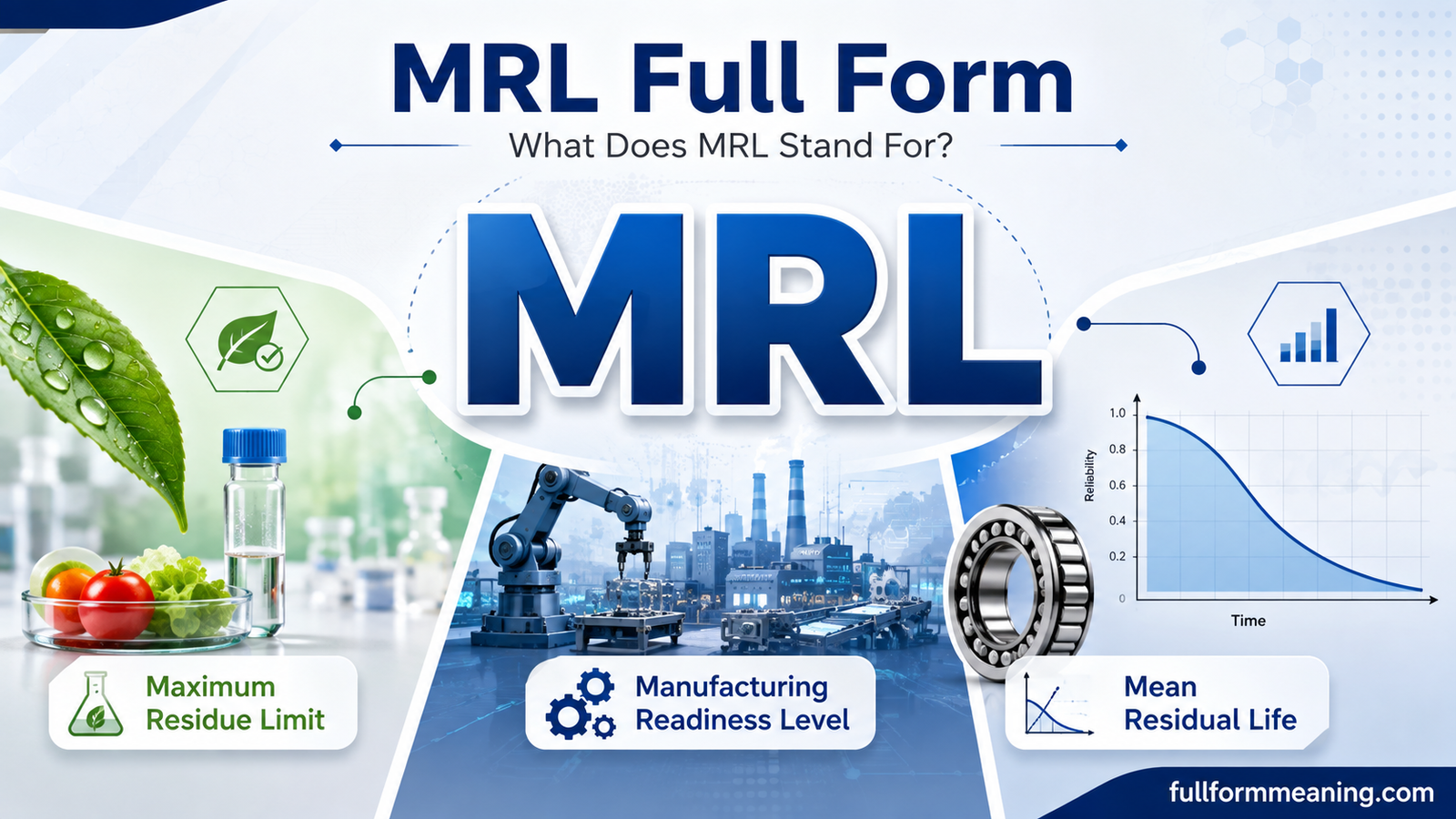
If you are searching for the MRL full form, the answer depends on the field in which the abbreviation is being used. MRL is a multi-context acronym with important meanings in food safety, agriculture, manufacturing, engineering, statistics, reliability, and survival analysis.
The most widely recognized meaning in food and agricultural regulation is Maximum Residue Limit. In manufacturing and technology development, MRL commonly means Manufacturing Readiness Level, while in statistics and reliability-related fields it can mean Mean Residual Life.
Understanding the context is therefore important before assigning one expansion to MRL.
MRL Full Form at a Glance
| MRL Full Form | Field | Basic Meaning |
| Maximum Residue Limit | Food safety, agriculture, veterinary medicine | The permitted concentration of a specified residue in food or feed |
| Manufacturing Readiness Level | Manufacturing, engineering, defense, technology | A scale used to evaluate manufacturing maturity and readiness |
| Mean Residual Life | Statistics, reliability, survival analysis | The expected remaining lifetime after a system or subject has survived to a specified point |
These meanings are not interchangeable. A food-safety document using MRL is discussing residue limits, while an engineering document may be assessing manufacturing maturity. In reliability analysis, MRL has a completely different statistical meaning.
What Does MRL Stand For?
MRL most commonly stands for Maximum Residue Limit in food-safety and agricultural contexts. The term refers to the highest concentration of a particular residue that is legally permitted or recognized as acceptable in a food or feed commodity under the applicable regulatory framework.
The Codex Alimentarius Commission defines an MRL for pesticides as a maximum concentration of pesticide residue, expressed in mg/kg, recommended to be legally permitted or recognized as acceptable in or on food commodities and animal feeds.
The term is also used for residues resulting from veterinary medicines. The European Medicines Agency describes an MRL as the highest concentration of residue accepted in an animal-derived food product following treatment with a veterinary medicine.
However, MRL does not always mean Maximum Residue Limit. In manufacturing, for example, it can refer to Manufacturing Readiness Level.
MRL Meaning: Maximum Residue Limit
What Is a Maximum Residue Limit?
A Maximum Residue Limit (MRL) is a regulatory limit established for a particular residue in a specified food or feed commodity.
Residues can come from substances such as pesticides used in agriculture or pharmacologically active substances used in veterinary medicine. The purpose of setting an MRL is to establish an acceptable regulatory level based on scientific assessment and the way the substance is used.
For pesticide residues, Codex MRLs are developed using toxicological assessments and residue data from supervised trials and authorized agricultural practices.
For veterinary medicines, the European Medicines Agency’s Committee for Veterinary Medicinal Products evaluates the safety of active substances and their residues and considers human dietary exposure when recommending MRLs.
Where Is Maximum Residue Limit Used?
This meaning of MRL appears frequently in:
- Food safety regulations
- Agricultural production
- Pesticide regulation
- Veterinary medicine
- Animal feed standards
- Food import and export controls
- Residue testing laboratories
- Regulatory compliance
- International food trade
For example, an agricultural authority may establish an MRL for a pesticide on a particular crop. A laboratory can then test a sample to determine whether the detected residue complies with the applicable limit.
Why Are MRLs Important?
MRLs provide a standardized way to manage chemical residues in food and agricultural commodities. They also help regulators, producers, laboratories, traders, and food businesses understand the limits that apply to specific substances and commodities.
An important point is that an MRL is not simply a statement that a chemical is harmless at any concentration. The value is established within a regulatory and scientific framework that considers factors such as toxicological information, dietary exposure, residue data, and authorized use patterns.
The OECD also maintains an MRL Calculator designed to help generate proposals for pesticide MRLs using residue data and statistical methodology.
MRL in Veterinary Medicine
MRL has a particularly important meaning in the regulation of veterinary medicines.
When animals raised for food receive certain veterinary medicines, residues of active substances or their metabolites may remain in products obtained from those animals. Regulatory agencies establish residue limits to help control consumer exposure.
For example, the European Medicines Agency states that MRL applications can involve establishing an MRL for a new pharmacologically active substance or extending an existing MRL to another animal species.
MRLs can therefore be associated with food products such as:
- Meat
- Milk
- Eggs
- Other products obtained from food-producing animals
The specific limit depends on the substance, animal species, food commodity, and applicable regulatory requirements.
MRL in Agriculture and Pesticide Regulation
In agriculture, MRL is commonly associated with pesticide residues.
When a pesticide is legally applied to a crop according to approved conditions, small amounts of residue may remain on or in the harvested commodity. Regulatory systems use residue limits to define acceptable concentrations for particular pesticide-and-commodity combinations.
The European Commission maintains legislation concerning maximum residue levels for pesticides in food and feed of plant and animal origin.
This means an MRL should not be interpreted as one universal number for every food. The applicable value depends on the particular chemical and commodity being considered.
Simple Example
Suppose a regulatory authority establishes an MRL for a particular pesticide on a particular crop.
A laboratory tests a sample from that crop and measures the residue concentration. The test result can then be compared with the applicable regulatory MRL.
This is one reason MRL information is important for farmers, food processors, exporters, importers, laboratories, and regulators.
MRL Full Form in Manufacturing
In engineering and technology development, MRL stands for Manufacturing Readiness Level.
This meaning has nothing to do with pesticide or veterinary-drug residues.
A Manufacturing Readiness Level is used to assess how prepared a technology or product is from a manufacturing perspective. The U.S. Department of Defense’s framework defines ten MRLs, numbered from MRL 1 through MRL 10.
The levels help organizations evaluate issues such as:
- Manufacturing processes
- Production capability
- Materials
- Equipment
- Supply chains
- Quality
- Manufacturing risks
- Production environments
- Cost considerations
- Continuous improvement
The concept is especially useful when a technology moves from research and development toward prototype production and eventually full-scale manufacturing.
What Do the Manufacturing Readiness Levels Mean?
The MRL scale progresses from early consideration of manufacturing implications toward mature production.
For example:
- MRL 1: Basic manufacturing implications are identified.
- MRL 2: Manufacturing concepts are identified.
- MRL 3: A manufacturing proof of concept is developed.
- MRL 4: Capability to produce the technology in a laboratory environment is demonstrated.
- MRL 5: Prototype components can be produced in a production-relevant environment.
The higher levels continue toward increasingly mature production capability. The DoD framework identifies MRL 10 as the final level and associates it with lean practices and continuous improvement for systems in production.
The Manufacturing Readiness Level Working Group also describes the framework as a way to identify, manage, and mitigate manufacturing risk and notes applications across defense, commercial industries, academia, and other manufacturing sectors.
MRL Full Form in Statistics and Reliability
In statistics, reliability engineering, and survival analysis, MRL can mean Mean Residual Life.
Mean Residual Life describes the expected remaining lifetime of an item, system, or subject that has already survived to a particular point in time.
In simple terms, imagine a machine has already operated for five years. Mean residual life asks:
Given that the machine has survived for five years, how much longer is it expected to operate?
This concept is used in reliability engineering and survival analysis. Academic literature describes MRL as an important measure for understanding expected remaining lifetime and for applications such as maintenance and replacement decisions.
Mean Residual Life Example
Suppose a group of identical components is being studied.
Researchers know that a component has already survived for a certain amount of time. Instead of asking only about the probability of immediate failure, they can use MRL to estimate the expected additional lifetime.
This can help engineers think about:
- Maintenance schedules
- Replacement decisions
- Equipment life
- Reliability analysis
- Remaining useful life
- Survival distributions
MRL is therefore a statistical concept rather than a regulatory limit.
Difference Between the Three Major MRL Meanings
| Feature | Maximum Residue Limit | Manufacturing Readiness Level | Mean Residual Life |
| Main field | Food and agriculture | Engineering and manufacturing | Statistics and reliability |
| Focus | Residue concentration | Manufacturing maturity | Expected remaining lifetime |
| Typical users | Regulators, farmers, laboratories, food businesses | Engineers, manufacturers, defense organizations | Statisticians, engineers, researchers |
| Example question | Is the residue within the permitted limit? | Is this technology ready for production? | How much lifetime remains on average? |
| Meaning of MRL | Maximum Residue Limit | Manufacturing Readiness Level | Mean Residual Life |
The surrounding words usually make the intended meaning clear.
For example:
- Pesticide MRL → Maximum Residue Limit
- MRL 7 → Manufacturing Readiness Level
- MRL function → Mean Residual Life
MRL vs. Similar Acronyms
It can be confused with other technical abbreviations because several terms relate to readiness, risk, or lifetime.
MRL vs. TRL
In manufacturing, it means Manufacturing Readiness Level, whereas TRL generally means Technology Readiness Level.
TRL focuses primarily on the maturity of the technology itself. MRL focuses specifically on manufacturing maturity and the ability to produce the technology reliably.
In many technology-development programs, both measures can be considered together because a technology may be technically mature without being ready for scalable production.
MRL vs. RUL
In reliability engineering, RUL means Remaining Useful Life.
RUL generally refers to the remaining time before a component or system is expected to reach a defined failure or end-of-use condition. MRL, by contrast, is an expected-value measure of remaining lifetime under a statistical model.
The two concepts are related, but they should not automatically be treated as identical.
Common Misunderstandings About MRL
MRL always means Maximum Residue Limit
Not necessarily. Maximum Residue Limit is a major meaning, particularly in food safety and agriculture, but Manufacturing Readiness Level and Mean Residual Life are also established uses.
One MRL value applies to every food
No. Residue limits are associated with specific substances and commodities under the relevant regulatory system. Codex, for example, publishes MRLs in relation to particular pesticide residues and food or feed commodities.
Manufacturing Readiness Level and Technology Readiness Level are the same
They are related but measure different aspects of maturity. Manufacturing Readiness Level concentrates on manufacturing capability and risk, while Technology Readiness Level evaluates technology maturity.
Mean Residual Life means the exact remaining lifetime
No. It is an expected remaining lifetime under the relevant statistical assumptions. Individual items can last considerably longer or shorter than the calculated mean.
How to Identify the Correct MRL Full Form
When you encounter MRL in a document, look at the surrounding terminology.
Maximum Residue Limit when you see words such as:
- Pesticide
- Food
- Crop
- Residue
- Veterinary medicine
- Animal feed
- Chemical
- Food safety
Manufacturing Readiness Level when you see:
- Manufacturing
- Production
- Prototype
- Technology
- Engineering
- MRL 1–10
- Manufacturing risk
- Production readiness
Mean Residual Life when you see:
- Reliability
- Survival analysis
- Lifetime distribution
- Hazard rate
- Remaining lifetime
- Failure
- Statistical model
This context-based approach is more reliable than assuming that every occurrence of MRL has the same expansion.
Key Takeaways
- MRL has multiple established full forms.
- Maximum Residue Limit is a major meaning in food safety, agriculture, pesticide regulation, and veterinary medicine.
- In engineering and manufacturing, MRL means Manufacturing Readiness Level.
- In statistics and reliability analysis, MRL means Mean Residual Life.
- The correct expansion depends on the surrounding context.
- Manufacturing Readiness Levels are commonly represented on a scale from MRL 1 to MRL 10 in the U.S. Department of Defense framework.
- Maximum residue limits are substance- and commodity-specific rather than one universal value.
- Mean Residual Life focuses on the expected remaining lifetime after survival to a specified point.
FAQs About MRL Full Form
1. What is the full form of MRL?
MRL has several meanings. The major ones are Maximum Residue Limit, Manufacturing Readiness Level, and Mean Residual Life. The correct meaning depends on the context.
2. What is the most common meaning of MRL in food safety?
In food safety, MRL commonly means Maximum Residue Limit. It refers to the permitted or recognized maximum concentration of a specified residue in a food or feed commodity under the applicable regulatory system.
3. What does MRL mean in agriculture?
In agriculture, MRL commonly refers to Maximum Residue Limit, particularly for pesticide residues in food and feed. Regulatory authorities use residue limits to establish acceptable concentrations for particular substances and commodities.
4. What does MRL mean in veterinary medicine?
In veterinary medicine, MRL can mean Maximum Residue Limit for residues of veterinary medicines or other relevant substances in food obtained from treated animals. The limits are established through scientific safety assessments.
5. What is MRL in manufacturing?
In manufacturing and engineering, MRL commonly stands for Manufacturing Readiness Level. It is used to evaluate how mature and prepared a technology or product is from a manufacturing perspective.
6. How many Manufacturing Readiness Levels are there?
The U.S. Department of Defense framework describes 10 Manufacturing Readiness Levels, numbered MRL 1 through MRL 10.
Conclusion
The MRL full form cannot be reduce to a single definition because the abbreviation is use across several specialize fields. In food safety and agriculture, MRL means Maximum Residue Limit, a regulatory concept used for controlling specified residues in food and feed. Engineering and manufacturing, it means Manufacturing Readiness Level, a framework for evaluating production maturity. Statistics and reliability, Mean Residual Life describes the expected remaining lifetime after an item or subject has survived to a particular point.
Therefore, the best way to understand MRL is to identify the subject area first. The words surrounding the abbreviation—such as pesticide, manufacturing, reliability, or survival—usually reveal which full form is intended.