NPPA Full Form: What Does NPPA Stand For?
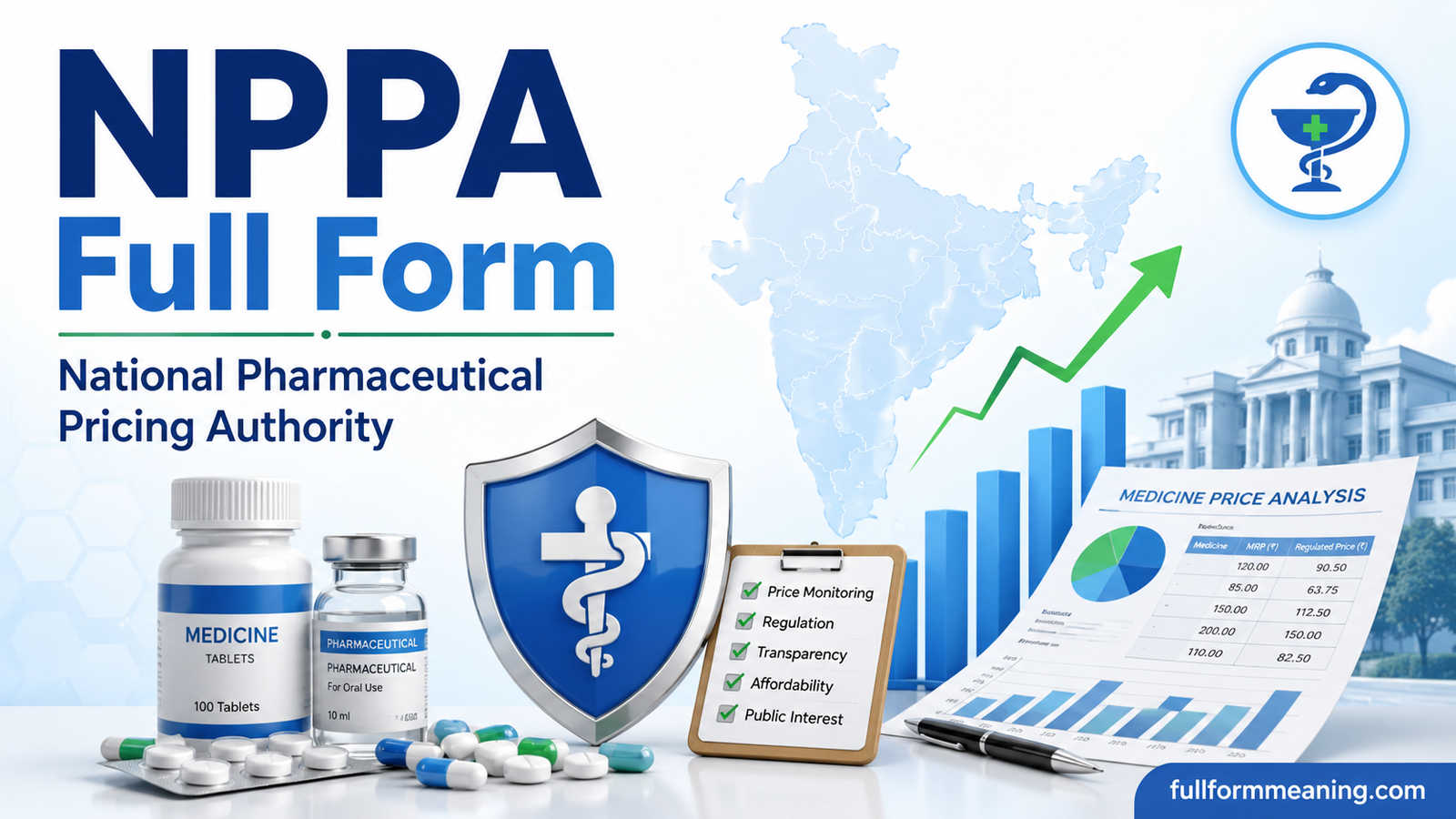
NPPA full form is National Pharmaceutical Pricing Authority. It is an Indian government authority responsible for regulating pharmaceutical prices and monitoring the availability of medicines. Established in 1997, it works within India’s pharmaceutical pricing framework to support the affordability, accessibility, and availability of medicines.
Its responsibilities are not limited to setting medicine prices. The organization also monitors compliance with applicable price-control rules, examines cases of overcharging, tracks the availability of medicines, and provides advice to the government on pharmaceutical pricing matters.
Quick Answer: NPPA Full Form
| Detail | Information |
| Full Form | National Pharmaceutical Pricing Authority |
| Abbreviation | NPPA |
| Country | India |
| Established | 29 August 1997 |
| Field | Pharmaceuticals and healthcare |
| Main Role | Regulation and monitoring of medicine prices |
| Related Regulation | Drugs (Prices Control) Order, 2013 |
| Administrative Department | Department of Pharmaceuticals |
| Ministry | Ministry of Chemicals & Fertilizers |
What Does NPPA Stand For?
NPPA stands for National Pharmaceutical Pricing Authority. The name describes its primary area of responsibility: pharmaceutical pricing.
In simple terms, it is a government body involve in determining and monitoring prices for medicines that fall under India’s applicable price-control system. Its work is design to balance medicine affordability with the need to maintain adequate availability in the market.
The authority is particularly important for medicines covere by the price-control framework establish under the Drugs (Prices Control) Order, 2013, commonly abbreviate as DPCO 2013.
What Is the National Pharmaceutical Pricing Authority?
The National Pharmaceutical Pricing Authority is a specialize government authority establish to handle pharmaceutical pricing matters in India.
It was constitute on 29 August 1997 through a Government of India resolution. It functions as an attached office of the Department of Pharmaceuticals, which comes under the Ministry of Chemicals & Fertilizers.
Its work involves several connected areas of pharmaceutical regulation. These include price fixation, price revision, market monitoring, medicine availability, enforcement of applicable pricing provisions, and policy advice.
Rather than treating medicine pricing as an ordinary commercial issue, the regulatory system considers the public-health importance of medicines. This is why pharmaceutical price regulation can have a direct effect on patients, healthcare providers, manufacturers and pharmacies.
Why Was NPPA Establish?
Medicine prices can influence whether patients are able to obtain the treatment they need. At the same time, pharmaceutical manufacturers operate in a commercial market with production, research, distribution and other costs.
A dedicated pricing authority was therefore create to help administer the government’s pharmaceutical price-control system.
The major objectives behind its work include:
- Regulating prices of medicines covered by the applicable framework
- Helping maintain reasonable medicine prices
- Monitoring the availability of important medicines
- Checking compliance with price-control requirements
- Addressing cases of overcharging
- Providing pharmaceutical pricing information to the government
- Supporting the development and review of pricing policy
This makes the authority relevant to both public health and the pharmaceutical industry.
Main Functions of NPPA
Understanding its functions gives a clearer picture of what the abbreviation represents.
1. Fixing Medicine Prices
One of its key responsibilities is fixing prices for medicines that fall within the applicable price-control provisions.
For scheduled formulations, the regulatory system provides for the determination of a ceiling price. This establishes the maximum permitted price according to the applicable rules.
2. Revising Prices
Medicine prices may change because of factors recognized by the applicable regulations. The authority can revise prices according to the procedures and conditions established under the relevant framework.
Annual revisions may also take economic indicators into account where the regulations provide for them.
3. Monitoring Medicine Prices
Price fixation alone is not sufficient. The authority also monitors the market to determine whether applicable pricing provisions are being follow.
This helps identify situations where medicines may be sold above permitted prices or where companies fail to follow relevant requirements.
4. Monitoring Availability
Affordable medicines are useful only when patients can actually obtain them.
For this reason, another important responsibility is monitoring the availability of medicines in the market. Where shortages are identified, appropriate steps may be taken under the applicable regulatory framework.
5. Dealing With Overcharging
If a manufacturer or other responsible party charges more than permitted under applicable price-control rules, the authority can take action according to the law.
This can include recovery of amounts that have been overcharge, along with applicable consequences under the regulatory framework.
6. Advising the Government
The authority also provides advice to the Central Government on pharmaceutical pricing policy and related matters.
This means its role includes both regulatory implementation and policy-related work.
7. Collecting and Studying Pharmaceutical Data
Pricing decisions require reliable information about the pharmaceutical market. The authority therefore undertakes or supports the collection, analysis and study of information relating to drug prices and related matters.
NPPA and DPCO: What Is the Difference?
NPPA and DPCO are closely related terms, but they do not mean the same thing.
| Term | Full Form | Meaning |
| NPPA | National Pharmaceutical Pricing Authority | The government authority responsible for pharmaceutical pricing-related functions |
| DPCO | Drugs (Prices Control) Order | The regulatory order containing provisions governing drug price control |
A simple way to remember the difference is:
NPPA = Authority
DPCO = Regulatory Order
The authority performs functions assigned to it under the applicable drug-pricing framework, including provisions of DPCO 2013.
What Is a Ceiling Price?
A ceiling price is the maximum price permit for a scheduled formulation under the applicable price-control provisions.
It is an important concept in pharmaceutical pricing because it establishes a limit rather than allowing manufacturers to charge any amount they choose for a medicine covered by the relevant provisions.
The calculation of a ceiling price follows the methodology established under DPCO 2013. It can involve market data, qualifying brands or generic versions and a prescribed retailer margin.
The actual calculation depends on the specific medicine and the applicable regulatory provisions.
How Does NPPA Affect Patients?
The work of the authority can affect patients primarily through medicine pricing and availability.
When a medicine falls under applicable price control, its permitted price is subject to the relevant regulatory requirements. This can help prevent excessive pricing and support affordability.
The impact can be particularly important for people who require medicines regularly. Even a relatively small reduction in the cost of a medicine can become significant when it is purchase repeatedly over a long period.
However, it is important to understand that not every medicine in India is subject to the same statutory price-control mechanism. Different medicines can fall into different regulatory categories.
How Does NPPA Affect Pharmaceutical Companies?
Pharmaceutical companies must comply with applicable pricing requirements for medicines covered by the relevant regulations.
Depending on the product and its regulatory status, companies may need to consider:
- Applicable ceiling prices
- Retail-price requirements
- Permitted price increases
- Price notifications
- Reporting requirements
- Compliance with DPCO provisions
- Requirements concerning overcharging
Manufacturers therefore need to monitor pricing notifications and regulatory changes carefully.
NPPA and Essential Medicines
The concept of essential medicines is closely connect with pharmaceutical price regulation.
India maintains a National List of Essential Medicines (NLEM), which identifies medicines considered important for healthcare needs. Changes to this list can influence the medicines covered by the country’s price-control framework.
The relationship between essential medicines and price regulation is important because essential treatments need to be both available and reasonably accessible to patients.
However, being list as an essential medicine and being subject to a particular price-control provision are relate concepts rather than terms that should automatically be treat as identical.
How Does Pharmaceutical Price Regulation Work?
The process can be understood in a simplified way:
- A medicine is identified under the applicable regulatory framework.
- Relevant market and product information is considered.
- The prescribed pricing methodology is applied.
- An applicable price is determined.
- The price is formally notified where required.
- Manufacturers and other relevant parties are expected to comply.
- Market prices and availability are monitored.
The exact procedure varies according to the medicine, its classification and the provisions that apply to it.
Why Is NPPA Important?
The authority is important because pharmaceutical products are not ordinary consumer goods. People may depend on medicines for managing illnesses, recovering from health problems or maintaining long-term treatment.
An effective pricing framework can help address several concerns:
- Affordability: Patients may find regulated medicines more accessible.
- Availability: Monitoring can help identify medicine shortages.
- Transparency: Official price notifications provide a regulatory reference.
- Consumer protection: Price-control provisions can help address overcharging.
- Market oversight: Pharmaceutical companies operate within defined regulatory requirements.
- Policy support: Pricing data can assist government decision-making.
Its importance therefore extends beyond a simple question of how much a medicine costs.
Common Misunderstandings
Several misconceptions can arise when people search for the NPPA full form.
It Is a Pharmaceutical Company
No. The National Pharmaceutical Pricing Authority is a government authority, not a medicine manufacturer.
NPPA and DPCO Are the Same
They are not. One refers to the authority, while the other refers to the regulatory order governing drug price control.
It Fixes Every Medicine Price
Not necessarily. Price control applies according to the relevant laws, schedules and regulatory provisions. Medicines can have different pricing treatment depending on their classification.
Its Only Function Is Price Fixing
Price fixation is important, but its responsibilities also include monitoring prices, medicine availability, compliance, overcharging and providing policy advice.
Example of NPPA in Everyday Life
Imagine that a medicine is covered by the applicable scheduled formulation price-control provisions.
A maximum permitted price may be determined according to the prescribed methodology. A manufacturer cannot simply increase the price beyond the permitted limit without considering the applicable rules.
If monitoring identifies a violation, regulatory action can follow according to the relevant provisions.
This simple example shows why pharmaceutical price regulation can directly affect consumers.
Related Terms You Should Know
Understanding the following terms can make pharmaceutical pricing easier to understand:
- DPCO: Drugs (Prices Control) Order
- NLEM: National List of Essential Medicines
- Ceiling Price: Maximum price permitted under applicable price-control provisions
- Retail Price: The applicable price for certain medicines under the relevant regulatory framework
- Scheduled Formulation: A formulation covered by the applicable schedule of the price-control order
- Department of Pharmaceuticals: The government department responsible for pharmaceutical-related policy and administration
- Pharmaceutical Pricing Policy: Government policy concerning the pricing of medicines
These terms frequently appear together in discussions about medicine prices in India.
Key Takeaways
Here are the most important points to remember:
- NPPA means National Pharmaceutical Pricing Authority.
- It is an Indian government authority related to pharmaceutical price regulation.
- It was established on 29 August 1997.
- It functions under the Department of Pharmaceuticals.
- It is associated with the Ministry of Chemicals & Fertilizers.
- Its work includes medicine price fixation and revision.
- It monitors applicable medicine prices and availability.
- It deals with overcharging under the relevant regulatory framework.
- DPCO 2013 provides an important legal framework for drug price control.
- A ceiling price represents the maximum permitted price for applicable scheduled formulations.
- The authority’s work affects patients, pharmacies, manufacturers and policymakers.
Frequently Asked Questions
What does NPPA stand for?
It stands for National Pharmaceutical Pricing Authority.
When was NPPA established?
The authority was constituted on 29 August 1997 through a Government of India resolution.
Which ministry is NPPA associated with?
It functions as an attached office of the Department of Pharmaceuticals under the Ministry of Chemicals & Fertilizers.
What is the main purpose of NPPA?
Its main purpose is to administer pharmaceutical price-regulation responsibilities and help support the availability and affordability of medicines under the applicable government framework.
What is DPCO?
DPCO stands for Drugs (Prices Control) Order. It establishes important provisions concerning the regulation of drug prices in India.
Conclusion
The NPPA full form is National Pharmaceutical Pricing Authority. Established in 1997, it plays a significant role in India’s pharmaceutical pricing system by handling responsibilities related to medicine prices, availability, compliance and government pricing policy.
For students, healthcare researchers and anyone trying to understand India’s medicine-pricing system, one distinction is especially useful: NPPA refers to the authority, whereas DPCO refers to the regulatory order governing drug price control.
Understanding these terms makes it easier to see how pharmaceutical prices are regulated and why medicine pricing remains an important part of healthcare policy.